
Blog
When Updating Parameters, RL Takes the Path Not Taken
Paper: The Path Not Taken: RLVR Provably Learns Off the Principals.
- Compared with SFT, RL training updates far fewer parameters;
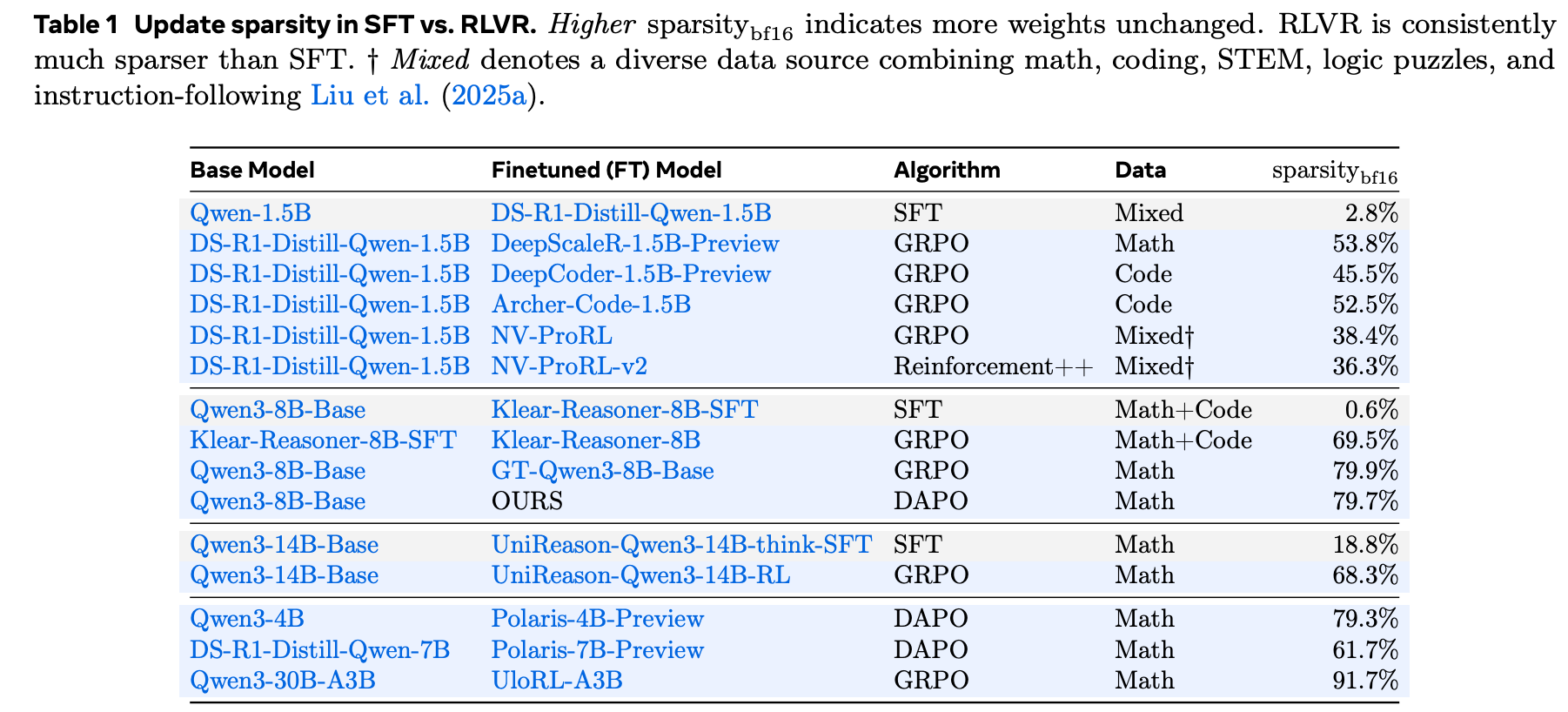
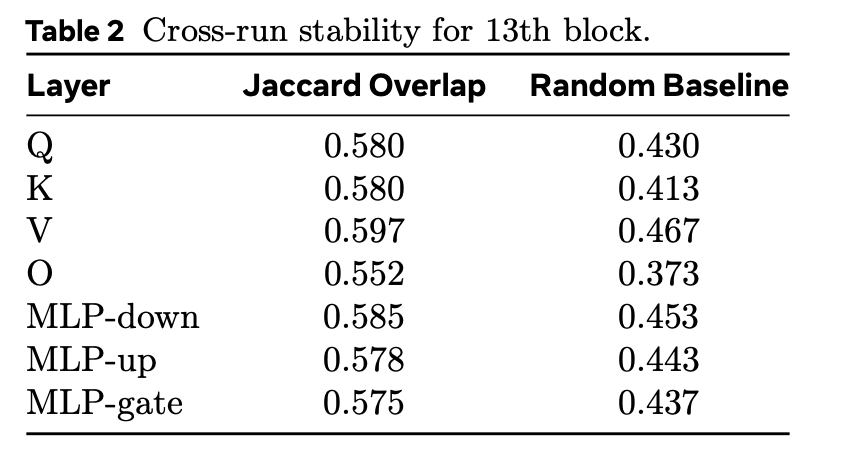
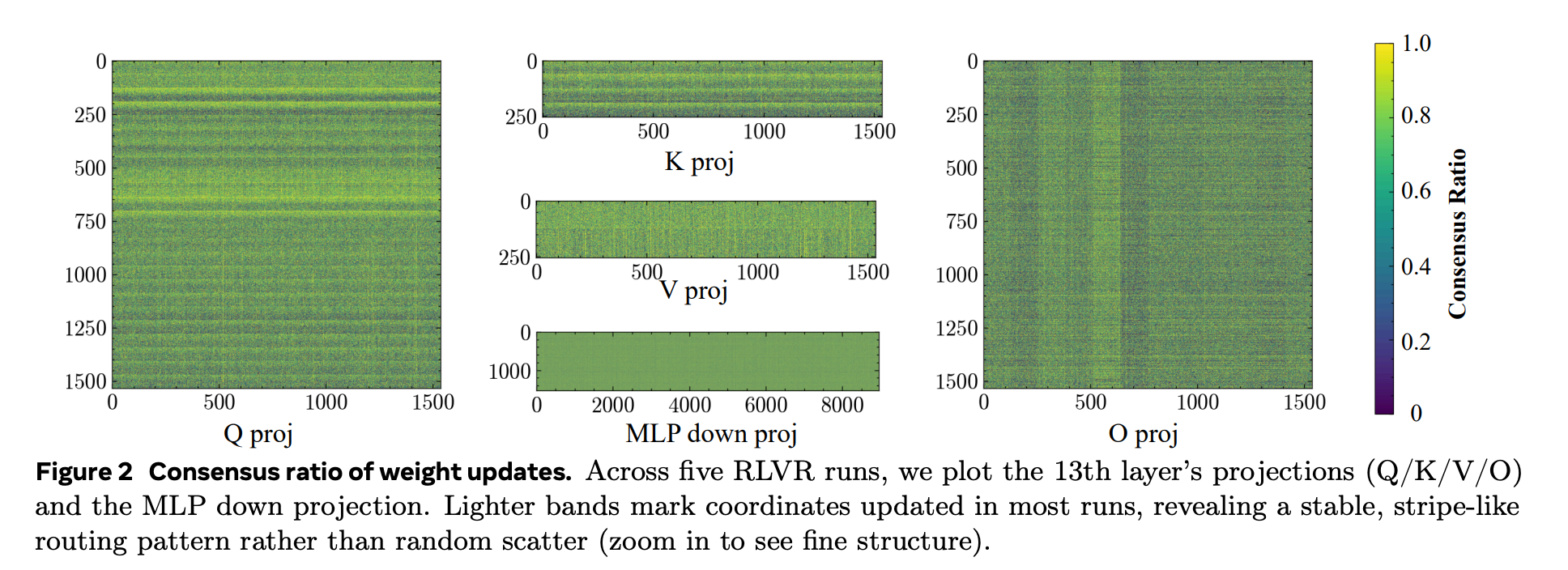
- Even more striking: the same pretrained model, fine-tuned with different RL algorithms and datasets, ends up with a high degree of overlap in its parameter update regions. This shows that RL's update trajectory is model-conditioned;
-
The authors propose a Three-Gate Theory to explain both phenomena:
- Gate I — the KL leash effect: each RL update step does not drift too far from the current policy, so the parameter changes stay small;
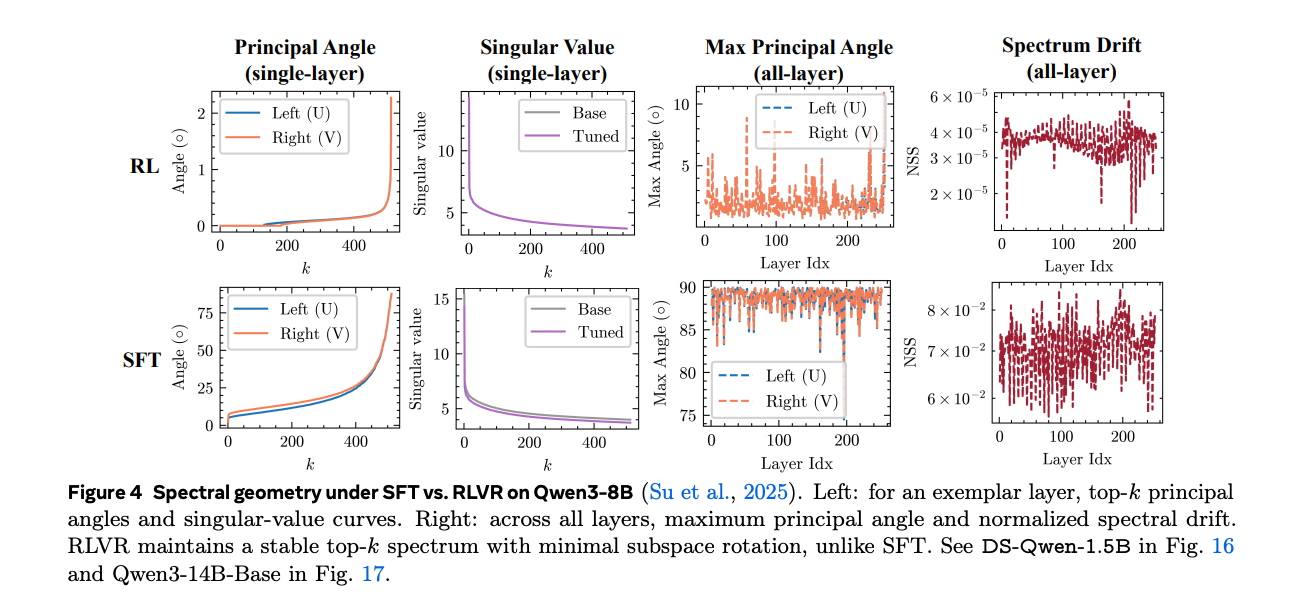
- Gate II — model geometry: constrained by the KL leash, RL only optimizes in directions that do not change the model's original parameter structure too much — i.e., the "off the principals" in the paper's title;
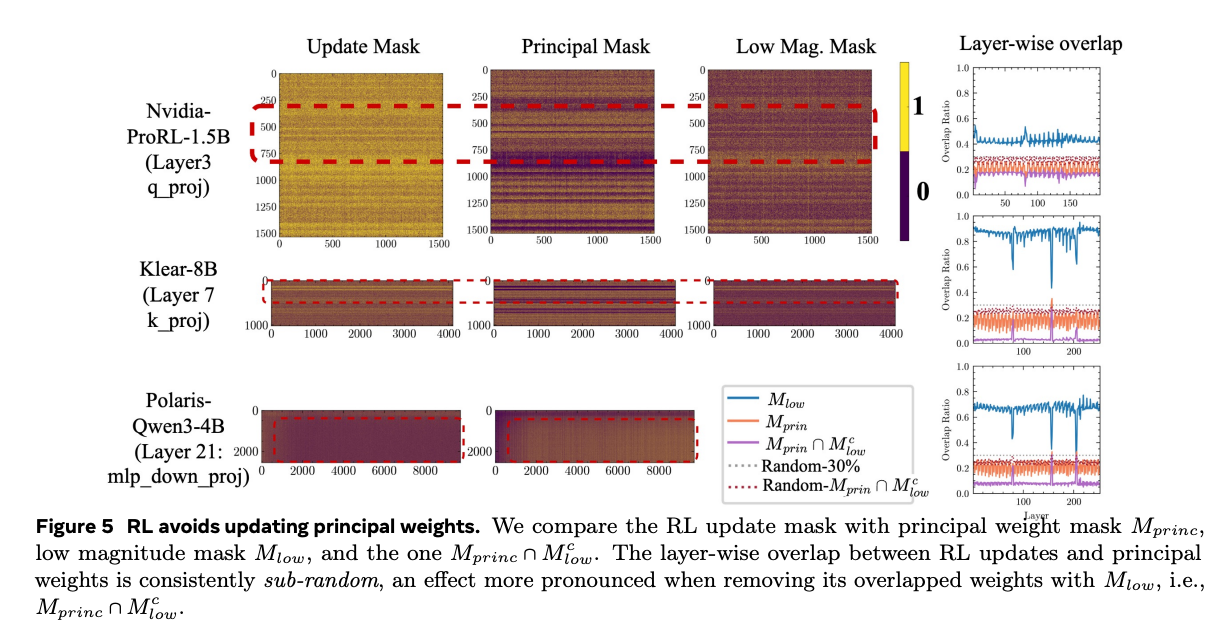
- Gate III — precision: the amplification effect of bf16 precision; because micro-updates get masked, the parameter updates become even sparser;
-
Gate I explains why the parameter changes are small; Gate II further explains why RL's parameter updates are model-conditioned;
-
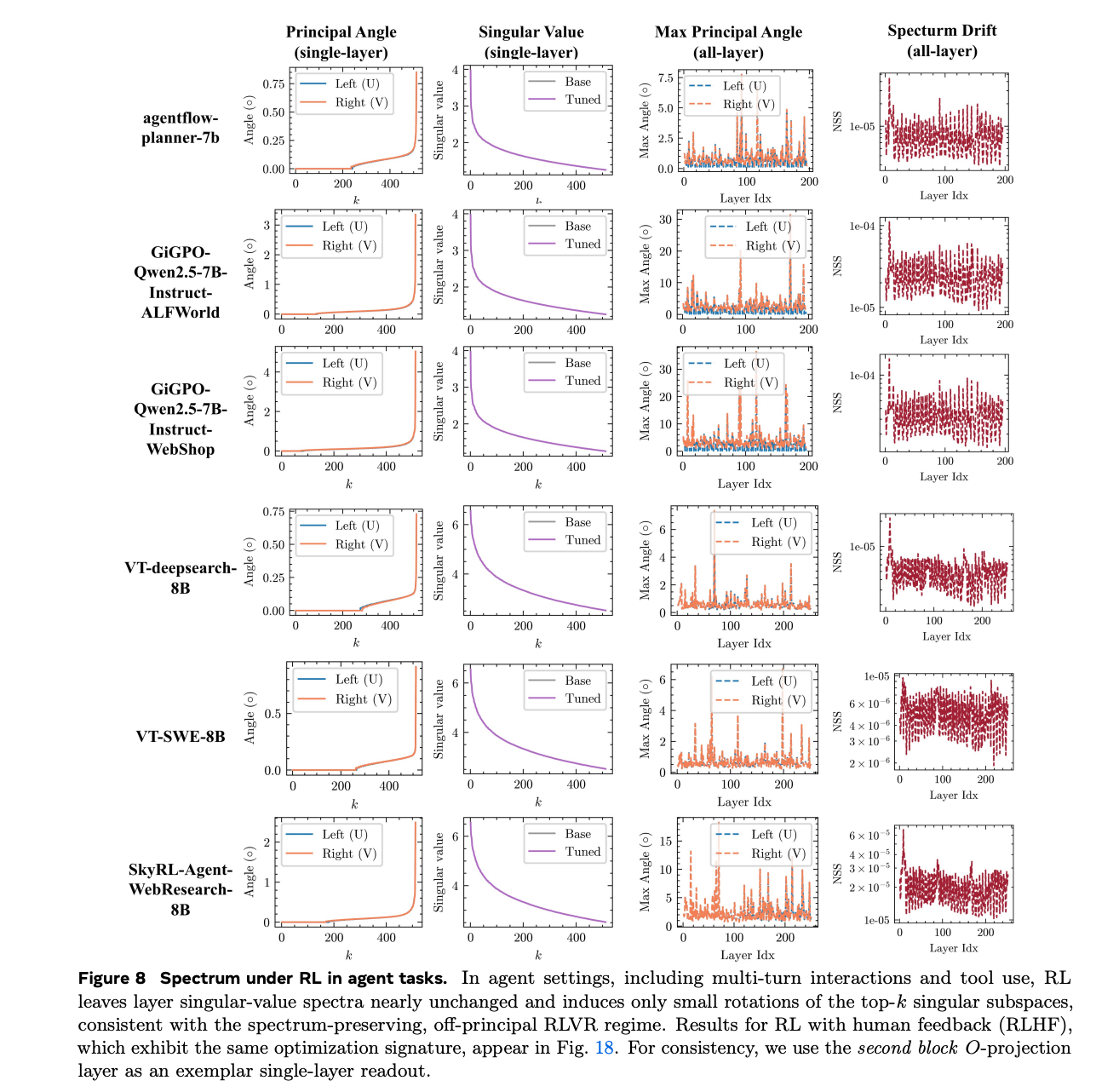
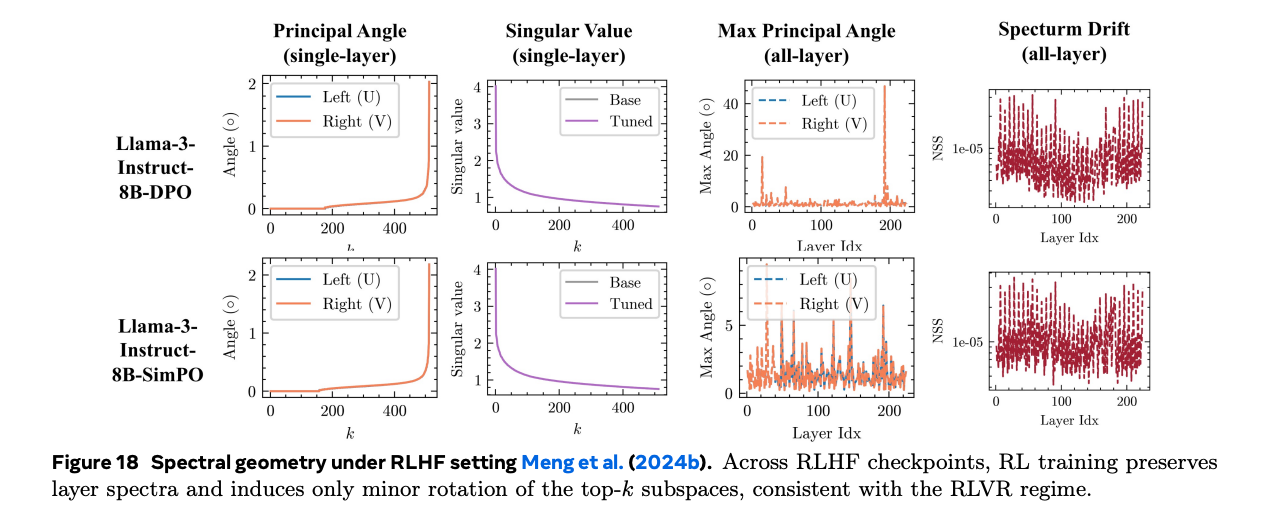
Beyond RLVR tasks, RLHF, Agentic RL, and DPO/SimPO all share the off-the-principals characteristic;
-
Even though DAPO removes the KL loss, its importance ratio + clipping still give it the KL leash effect; DPO has an implicit KL regularization, so it has the KL leash effect too; SimPO has no implicit KL regularization, but its training tricks also keep the KL divergence low (see the original SimPO paper);
-
SFT updates on the principals — the exact opposite of RL. Therefore, PEFT improvement techniques that suit SFT (such as PiSSA) are not necessarily good for RL; RL deserves PEFT techniques of its own;
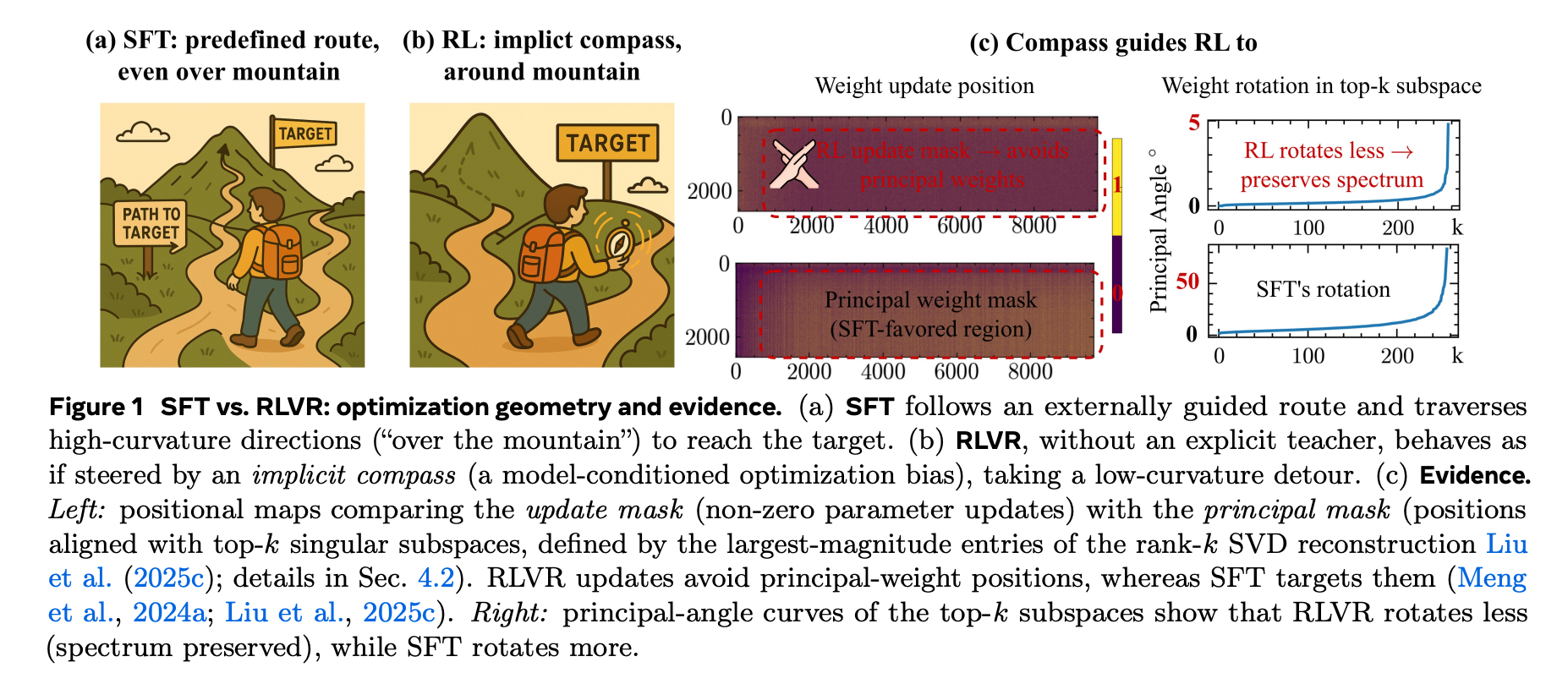
- The following known phenomena echo this paper nicely: RL only needs a low-rank LoRA to approach full fine-tuning performance; RL generalizes better while SFT leans toward memorization.
References
[1] The Path Not Taken: RLVR Provably Learns Off the Principals